The short answer: one year animal versus four birth pillars
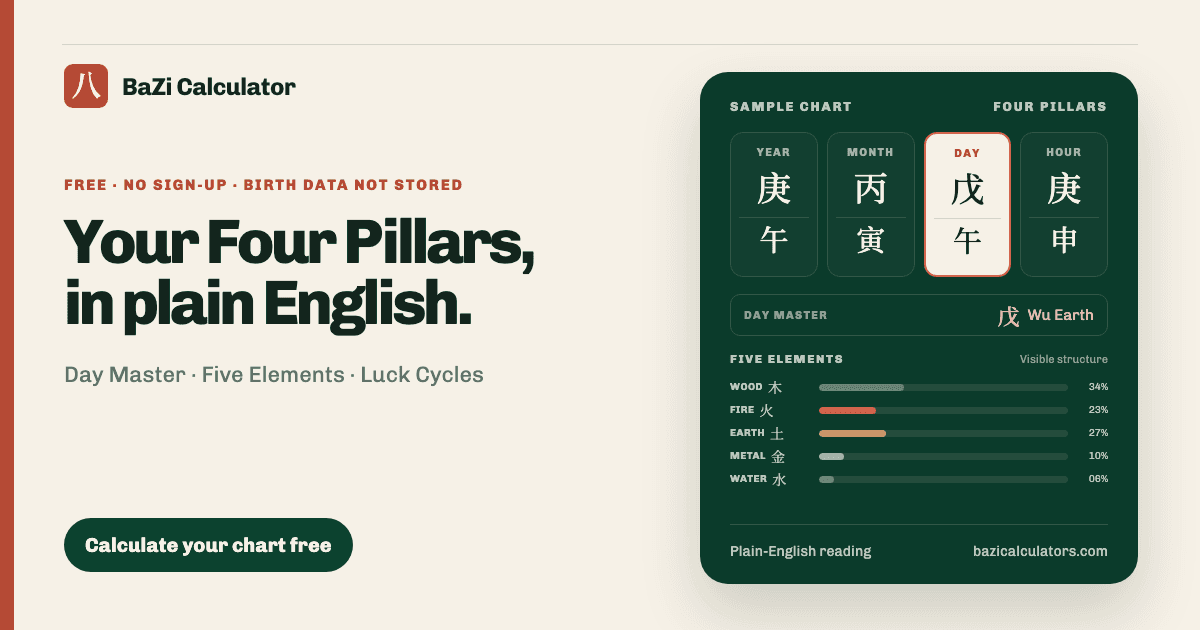
The Chinese zodiac usually gives you one of twelve animals from your birth year. BaZi uses the year, month, day and hour of birth to form four pillars. Each pillar contains one Heavenly Stem and one Earthly Branch, so a complete chart has eight characters — the literal meaning of BaZi.
Your zodiac animal is not outside BaZi. It corresponds to one Earthly Branch in the Year Pillar. That makes it a real part of the chart, but not the whole chart and not the Day Master that a BaZi reading uses as its central reference point.
The two systems answer different-sized questions. A zodiac animal is a familiar cultural label shared by everyone in the same zodiac year. A BaZi chart records a more specific birth-time structure. Neither should be treated as a scientifically validated prediction or a fixed verdict about a person.
BaZi and the Chinese zodiac side by side
The simplest comparison is not which system is better. It is how much birth information each one uses and what kind of output that information can support.
Why the zodiac animal is one character, not the whole BaZi chart
The Hong Kong Observatory documents the twelve animal cycle as a mapping to the twelve Earthly Branches. It also documents how one Heavenly Stem pairs with one Earthly Branch to form the sixty Stem-Branch combinations, and how the Gan-Zhi of year, month, day and hour together form the Eight Characters.
That relationship explains the overlap precisely. If your zodiac animal is Horse, Horse corresponds to the Wu Earthly Branch in the year position. The complete Year Pillar also has a Heavenly Stem, while the Month, Day and Hour Pillars add three more stems and three more branches. Calling the year animal your full BaZi result leaves seven characters out of view.
It also confuses the zodiac animal with the Day Master. The Day Master comes from the Day Stem, not the Year Branch. Two people can share the same zodiac animal while having different birth seasons, Day Masters, visible Five Element distributions and Hour Pillars.
Does a BaZi chart give you four zodiac animals?
In a technical sense, every Earthly Branch has an animal correspondence, so the branches in the Year, Month, Day and Hour Pillars can all be shown with animal labels. A complete chart might therefore display four familiar animals. That does not mean you have four independent Chinese zodiac signs in the popular horoscope sense.
The animal is a readable label for the branch, while the branch carries a place in the chart, a Five Element association, hidden stems and relationships with the other characters. A Rabbit in the Month Pillar is not interpreted by copying a generic Rabbit-year description into the month position. Its meaning depends on the whole Stem-Branch structure and the calculation method being used.
Animal labels are useful for orientation, especially for beginners who recognize Dragon or Snake before they recognize Chen or Si. The safe mental model is: one popular birth-year zodiac animal, plus four BaZi branches that happen to share the same twelve-animal vocabulary. The shared symbols make the systems related; the different structure keeps them from being interchangeable.
Boundary dates can produce two different-looking answers
People born in January or early February need an extra method check. Popular Chinese zodiac tools commonly change the animal year at Lunar New Year. Some BaZi and other Chinese astrology methods instead form the Year Pillar around Li Chun, the Beginning of Spring solar term. Lunar New Year and Li Chun are different calendrical markers and do not always fall on the same date.
This does not mean one screen must be wrong. It may mean the screens are answering different questions under disclosed conventions. A cultural zodiac lookup can use the lunar-year boundary, while a Four Pillars calculation can use a solar-term boundary. Near either boundary, the tool should show its rule instead of presenting an animal label without context.
Month Pillars make the distinction even clearer. BaZi months are organized around solar terms rather than simply copying Gregorian or lunar month numbers. A complete chart therefore needs more boundary logic than a birth-year animal lookup.
What each system is useful for
Use the Chinese zodiac when you want the familiar year animal, its cultural cycle or a quick way to explore how one birth year is represented. That is the right scope for Zodiac Weave's year-animal and Chinese × Western zodiac experience; it does not claim to be a full Four Pillars chart.
Use BaZi when you want to see the Year, Month, Day and Hour structure, identify the Day Master, inspect the Five Elements and Ten Gods, or follow Luck Cycles under a stated calculation method. The extra structure does not make every interpretation objective. It makes the inputs and calendrical steps more specific and therefore easier to audit.
While building this calculator, this distinction became a product rule: show the actual pillars first, explain the method, and keep missing birth time missing. A simple animal label is useful when that is what the user asked for; it should not be stretched into a complete personalized chart.
How to tell which result you are looking at
A result showing only Rat, Ox, Tiger or another year animal is a Chinese zodiac result. A BaZi result should display at least the Year, Month and Day pillars, with the Hour Pillar included only when the birth time supports it. Each visible pillar should have both a Stem and a Branch.
Next check whether the result identifies a Day Master. If the page calls the year animal your core element without showing the Day Stem, it is not explaining the BaZi structure. Finally, check the boundary convention: Lunar New Year, Li Chun, civil time, solar time and the day-change rule should not be hidden when they can alter a pillar.
The practical choice is simple: use the zodiac for a broad year symbol and BaZi for the Four Pillars. Enjoy either as a cultural framework for learning and reflection, but do not use an animal sign or an automated chart as certainty about health, money, relationships or major life decisions.
Calendar and system references
Sources and method notes
The Observatory references document the calendar cycles and solar terms. The Four Pillars overview describes the wider BaZi structure, while Zodiac Weave owns the separate year-animal experience. These sources do not prove scientific validity or one universal interpretation standard.
- Hong Kong Observatory — the 12-year animal cycle and its Earthly Branch mapping
- Hong Kong Observatory — Heavenly Stems, Earthly Branches and the Eight Characters
- Hong Kong Observatory — an introduction to the 24 Solar Terms
- Four Pillars of Destiny — overview of the four Stem-Branch pairs and Day Master
- Zodiac Weave — the year-animal scope of Chinese zodiac compared with Western signs