First, find out what actually changed
Why do BaZi calculators give different results from the same birthday? Usually, either the tools are not using identical birth data and calculation rules, or the Four Pillars are the same while the written interpretations differ. Check the Year, Month, Day and Hour Pillars first. That one comparison tells you whether you have a calculation question or a reading question.
If only the prose changes, the disagreement is interpretive. BaZi schools and readers can weigh strength, useful elements and timing differently even when they begin with the same chart. If a pillar changes, look upstream: date system, solar-term boundary, birthplace, historical clock rules, true solar time, day boundary or an unknown birth hour.
This distinction matters because an explanation can feel personal without proving that its underlying chart is right. BaZi calculator accuracy starts with a reproducible chart, not with how closely a paragraph seems to describe you.
The pillars and the reading are two different layers
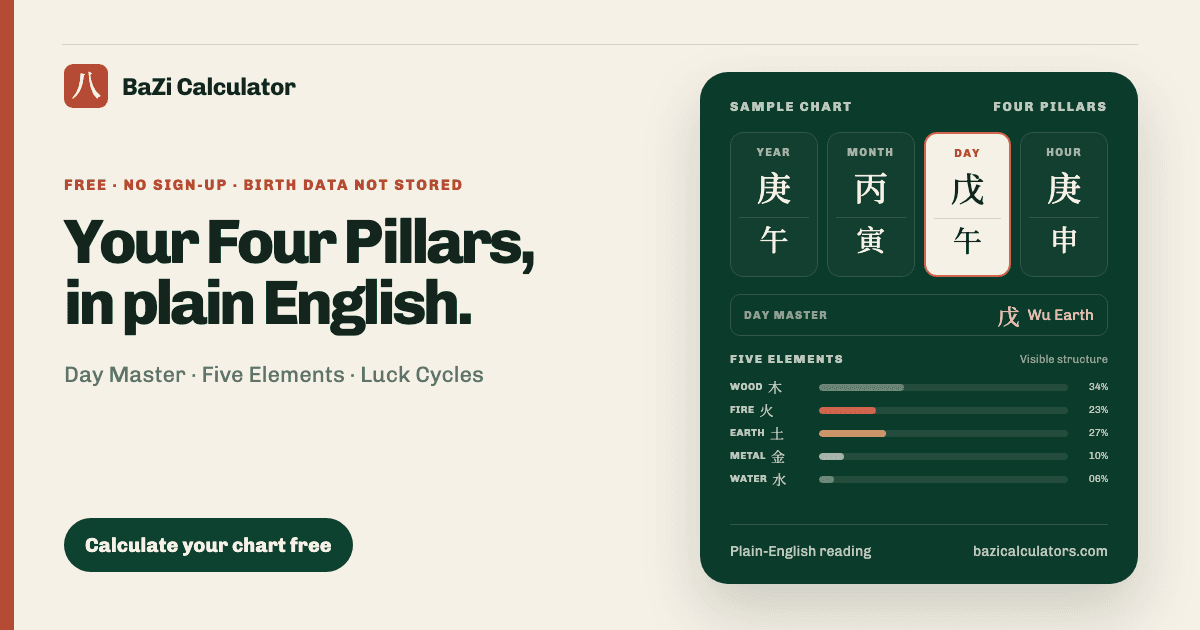
A BaZi tool does two jobs. First, it converts a birth moment into the Four Pillars: one stem and one branch for the Year, Month, Day and Hour. Second, it interprets relationships in that structure—the Day Master, Five Elements, Ten Gods and timing cycles. The first layer should be repeatable when the inputs and conventions match. The second layer contains judgment.
That is why asking a general-purpose chatbot to calculate and interpret a chart in one step is difficult to audit. Fluent text can hide a wrong Month Pillar or Hour Pillar. A clearer workflow calculates the chart with fixed calendar rules, keeps those pillars visible, and only then adds a plain-English reading.
When BaZi calculators give different results, copy the four pillar pairs before comparing any personality or forecast language. If the eight characters match, you do not need to keep searching for a different birthday calculation; you are comparing interpretations.
Solar terms can change the Year or Month Pillar
BaZi month boundaries follow solar terms, often called Jie Qi, rather than the first day of a Gregorian month. The BaZi year boundary is also commonly tied to Li Chun, the Beginning of Spring, rather than January 1 or the date of Lunar New Year. A birth close to one of these boundaries can therefore belong to a different Year or Month Pillar than a date-only shortcut suggests.
The boundary is a moment, not simply the label “February 4.” Its exact local time matters. A tool that knows the date but ignores the time may silently choose one side. A tool that knows the civil time but applies a different location or solar-time rule may place the same recorded birth moment on the other side.
This is also why unknown birth time needs special handling on a solar-term day. Away from a boundary, Year, Month and Day can still form a useful three-pillar chart. On a date when the Year or Month changes during the day, pretending the time does not matter can return a confidently wrong partial chart.
Birthplace, time zone and historical clock rules matter
A city is more than a label under the chart. It connects the recorded local clock time to the place where the birth happened. Countries and regions have changed offsets, borders and daylight-saving rules over time. Looking up today’s offset and applying it to a birth decades ago can move the calculation by an hour—or more. Historical daylight saving time must be resolved for the birth date, not copied from today’s clock.
This is a common answer to “why is my BaZi chart different?” when two tools accept the same displayed hour but only one asks for a birthplace. Even tools that both ask for a city may use different historical clock data, may fall back to a nearby place, or may not disclose what happens when a location lookup fails.
Enter the local time as it was recorded at birth. Then compare the resolved city and the historical offset the tools actually used. Do not manually subtract daylight saving time unless the method explicitly tells you to; otherwise it can be corrected twice.
True solar time can move the Hour Pillar
Civil time is shared across a time zone. True solar time adjusts that clock time toward the sun’s apparent position at the birthplace, using longitude and the seasonal Equation of Time. Because a BaZi Hour Pillar covers a two-hour branch, a correction matters most when the birth is close to a branch boundary.
True solar time does not automatically change every chart. A 20-minute correction in the middle of an hour branch may leave the Hour Pillar untouched. The same correction near 11:00, 13:00 or another boundary can move the birth into the neighboring branch. Extreme longitude within a wide time zone can create a much larger shift.
Different traditions also make different choices: some use recorded civil time, some apply longitude-only mean solar time, and some apply apparent or true solar time. Transparency is more useful than a badge that says “accurate.” A method should tell you which convention it uses and show enough detail to reproduce the result.
The day boundary is a convention that should be disclosed
Late-night births can change the Day Pillar and therefore the Day Master. Some BaZi methods change the day at midnight. Others treat the start of the Zi or Rat hour at 23:00 as the next BaZi day, and some distinguish early and late Zi in more detailed ways. Two tools can therefore disagree even after matching the city and solar time.
This calculator changes the day at midnight. That is a deliberate, tested convention, not a claim that every school must use it. A calculator using a 23:00 boundary may return a different Day Pillar for a birth between 23:00 and 00:00 without either result being a random software error.
The warning sign is not disagreement by itself. It is an undisclosed rule. If a late-night chart differs, ask both tools when their calculation day begins and whether that check happens before or after any solar-time adjustment.
Unknown birth time should reduce certainty, not create a neat fiction
An unknown birth time means the Hour Pillar is unknown. Filling the field with noon may make a result screen look complete, but it creates information the user did not provide. A more honest result keeps the Year, Month and Day Pillars, removes hour-dependent claims and explains the limit.
There is one extra edge case: if the date itself crosses a solar-term boundary, the missing time can make even the Year or Month uncertain. Our calculator checks the beginning and end of that local civil date under the same location and solar-time rules. If the pillar changes, it asks for a birth time instead of selecting one side silently.
Three reproducible cases from our regression tests
These are synthetic golden cases from the calculator’s automated regression suite, not real user birth records. They show how a small-looking input or rule change can reach a different pillar. They also make the method falsifiable: the same input should keep returning the same output after code changes.
A seven-step checklist for comparing two BaZi charts
Put the two results side by side and work from inputs to outputs. This is faster than reading two long interpretations and deciding which one feels more accurate.
What this calculator does—and what it cannot prove
Our BaZi calculator asks for a birthplace, resolves the historical local clock basis, applies true solar time, uses solar-term boundaries and changes the day at midnight. It calculates the chart before requesting any AI-written explanation. When birth time is unknown, it returns only the reliable pillars or asks for time if that date crosses a Year or Month boundary.
Those choices make the result reproducible under the method we publish. They do not make BaZi a scientific test, prove one school universally correct or guarantee that an interpretation predicts a life. I am a Chinese maker and BaZi enthusiast, not a professional practitioner. I built the tool for learning, reflection and a little fun, with enough method detail that you can question the result rather than simply trust it.
If you are comparing charts now, start with the pillars and the seven checks above. Then calculate your chart again with the rules visible. The useful question is not only which answer looks confident, but whether you can explain how that answer was formed.
Calculation references
Sources and method notes
Competitor method pages describe their own conventions; they do not prove a universal BaZi standard. The three cases above are regression evidence for this calculator, not an industry accuracy rate or a claim that every school must return the same chart.
- Official Time Zone Database — current and historical civil-time changes
- NOAA Global Monitoring Laboratory — solar calculation references
- ZodiacTales — a current exact-question page covering pillar differences
- ChiBuddy — a documented true-solar-time and historical-DST convention
- A representative public discussion about location and calculation assumptions