The short answer: the bar and the branch count different things
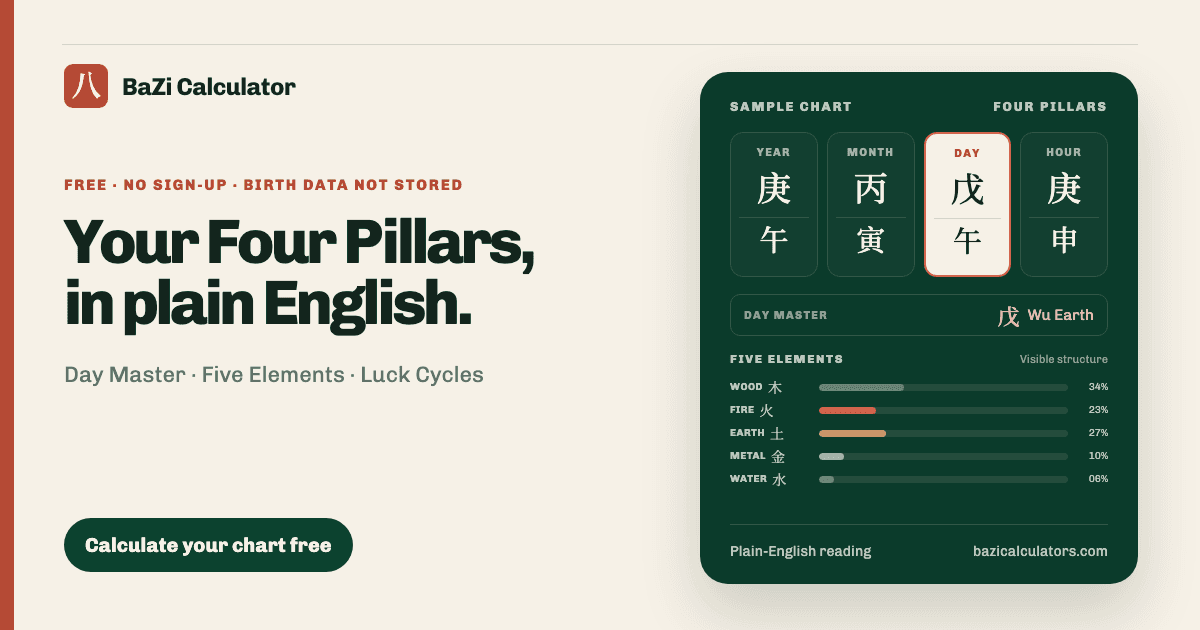
Yes, a BaZi chart can display 0% Water while listing a Water hidden stem beneath an Earthly Branch. In this calculator, the percentage bar counts each visible Heavenly Stem and each branch's main element once. The hidden-stem list shows the stems associated with that branch separately. It does not add them to the bar.
That is a display convention, not a claim that hidden stems are irrelevant. A zero means there are no Water entries in this particular visible count. It does not mean Water is absent from every layer of the chart, that you need more Water, or that something is wrong with you.
Before comparing two calculators, ask what each percentage actually measures. A visible character count and a hidden-stem-weighted score can differ even when the underlying four pillars agree.
Where the extra stems come from
A complete BaZi chart has four pairs: one Heavenly Stem above one Earthly Branch in each pillar. The Hong Kong Observatory describes this year, month, day and hour Stem-Branch structure as the Eight Characters. The smaller characters beneath a branch are not extra birth pillars.
Hidden stems, or cang gan (藏干), are stems assigned within the branches in the traditional framework. The chapter on ren yuan in San Ming Tong Hui discusses this internal layer in a seasonal context. It is historical evidence for the distinction, not an instruction to turn every hidden stem into an equal percentage point.
For example, our chart displays Chen (辰) as Earth at the branch level, with Wu (戊, Earth), Yi (乙, Wood) and Gui (癸, Water) beneath it. These are two descriptions of the same branch: its main element for the visible summary, and its internal stem list for further inspection. The specific list here is the convention used by this calculator, not a claim that every historical text uses identical labels or ordering.
A tested example: 0% Water with Water hidden stems
Take a synthetic example, not a real user's birth record: February 4, 2024 at 16:45, using our Shanghai test location at longitude 120° east, the historical local clock, true solar time and the midnight day-change rule. Under this calculator's method, the four pillars are 甲辰 / 丙寅 / 戊戌 / 庚申. The following arithmetic is checked against the actual calculation adapter, not an illustrated mock chart.
Read the eight visible positions once each. The four stems contribute Wood, Fire, Earth and Metal. The four branches contribute Earth, Wood, Earth and Metal. That gives eight entries in total, with no Water entry.
Why we don't simply add every hidden stem
Adding all the hidden characters would create a different summary, not repair this one. You would first need to decide whether to replace the branch entry with its hidden stems or keep both. Keeping both can count the branch's main element once as the branch and again as its main hidden stem.
You would also need an explicit weighting rule. Should a branch with three hidden stems contribute three equal units while a branch with one contributes only one? Or should every branch keep the same total weight and split it internally? These are different questions from counting the eight visible positions. Neither follows automatically from the word hidden.
Our product keeps the simpler count and labels its limits. It does not assign hidden-stem weights, calculate seasonal strength or turn the longest bar into a Favorable Element. You can inspect the underlying stems without treating a convenient graphic as a complete traditional reading.
How to compare two Five Element charts
First compare the actual pillars. If a Stem-Branch pair differs, resolve the birth input, clock correction and boundary convention before comparing percentages. If the pillars agree, check the summary's counting method next.
Ask whether the chart counts visible stems plus branch main elements, replaces branches with hidden stems, or applies additional weights. Then check its denominator and rounding. In our Four-Pillar Chart the denominator is eight. In a Three-Pillar Chart it is six, because the unknown Hour Pillar is omitted rather than guessed. Percentages are rounded to one decimal place, with the final category adjusted so the displayed total is 100%.
Finally, keep distribution separate from interpretation. The number of entries is reproducible arithmetic. Whether an element is strong, weak or useful requires a stated interpretive method; it cannot be read directly from a bar. A different percentage alone does not establish that one calculator is more accurate.
What to do when an element looks missing
Open the branch details and check whether the element appears in the hidden-stem lists. If it does, describe the result precisely: absent from the visible count, present in a hidden stem. If it does not, you still have a statement about the available chart data, not a diagnosis or a prescription.
When birth time is unknown, keep the missing pillar in mind. A six-position summary describes the three known pillars only. It cannot establish what the Hour Pillar or its hidden stems would add.
The practical takeaway is to read the label before the number. Our percentage bars give a quick, checkable orientation; the branch details preserve another layer. Enjoy BaZi as a cultural framework for learning and reflection, not as a scientifically validated prediction or a reason to make health, money or major life decisions.
Structure and method references
Sources and method notes
The Observatory documents the calendar structure; the classical text records a traditional interpretive framework, not a modern percentage standard. The synthetic example and counting rule describe this calculator's tested behavior only. Neither source establishes scientific validity or universal hidden-stem weights.