First, what "missing" actually means
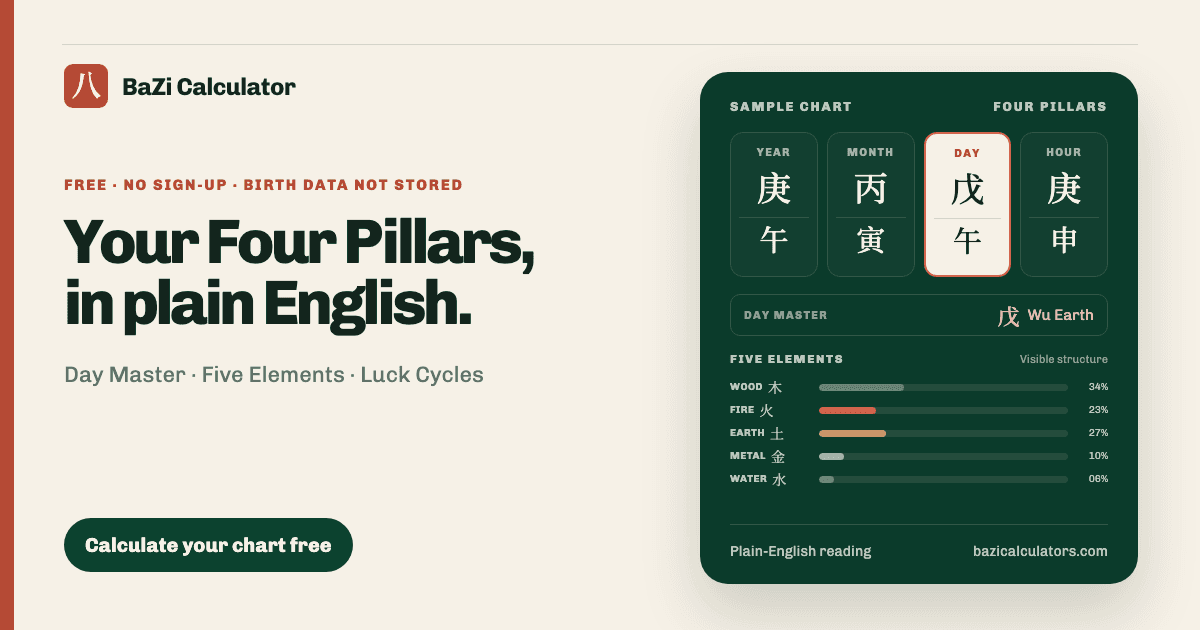
A BaZi chart contains eight characters: a Heavenly Stem and an Earthly Branch for each of the Year, Month, Day and Hour Pillars. Each character carries one of the Five Elements, and adding the Hidden Stems inside the branches gives a full distribution. When a tool says an element is missing, it means that element does not appear anywhere in those eight characters — its count is zero.
That is a structural observation about the chart, not a statement about your life. As one current BaZi guide puts it, a missing element is not gone from your life; it is structurally absent from your chart's default operating pattern. The element may still show up in the way you interact with your environment, your career or the people around you.
So when the calculator displays "missing Wood" or "no Water", treat that as the starting point of a distribution, not as a diagnosis that something is wrong.
Missing is not the same as weak or unfavorable
Three terms get mixed together in casual BaZi conversation, and they answer different questions. "Missing" describes quantity: an element is entirely absent. "Weak" also describes quantity, but with structure: the element exists and is overwhelmed, restrained or poorly placed. "Unfavorable" describes function: the element is harmful to this particular chart no matter how much of it exists.
Separating these matters because a chart can be missing an element that it actually needs, missing an element that would hurt it, or weak in an element it still uses. The distribution alone cannot tell you which case you are in.
Why counting characters is not measuring strength
Five Element strength in BaZi is judged from the seasonal command, the roots and support each element receives, and the overall structure — not from a character count. A month that commands the season can make one element powerful even when it appears only once, while an element that appears three times can still be hollow if it has no root and sits in a hostile season.
Counting methods exist, but even their authors warn against treating them as the final word. A step-by-step analysis guide from FateClick walks through assigning points to each element and then immediately cautions that just because an element is "missing" does not mean you should rush to supplement it — balance is key. The count is a teaching tool; the balance question is the real analysis.
A reliable calculator can show the distribution exactly. Whether one element is strong, weak or useful is a separate layer that depends on method and interpretation.
The "fill what's missing" shortcut, and why it is a misconception
"Fill what's missing" is the most widespread and harmful misconception in BaZi, according to a 2026 guide dedicated to the exact question. The element that determines what a chart needs is the Favorable God, and it may be an element you already have in plenty rather than the one you are missing. The missing element can even be an Unfavorable God, in which case supplementing it makes the imbalance worse instead of better.
The guide gives two opposite examples: a summer-born chart full of Fire and Earth with no Water may genuinely need Water to cool it, while a weak Day Master that is missing Metal should not be given more Metal, because Metal is the element that restrains an already weak self. Both charts are missing an element, and the correct action is opposite. The distribution cannot decide this; the Favorable God analysis does.
Community discussions reflect the same disagreement. A long-running BaZi forum thread asks whether a missing element should be strengthened instead of the Favorable Element, and the answers split along school lines — which is exactly why a calculator should report the distribution and stop there rather than sell a supplement prescription.
What our calculator shows — and what it does not
Our BaZi calculator displays the Five Element distribution of the eight characters, including which element is missing and how the visible characters weigh against each other. That distribution is deterministic, reproducible and easy to check: same birth data, same pillars, same counts.
It does not tell you to wear a color, move in a direction or add a character to a name. Strength and Favorable God judgment require the Day Master analysis, seasonal adjustment and method-specific rules described above — different schools disagree, and a distribution fact is not a supplement prescription.
This keeps the boundary honest: the tool owns the calculation layer and shows it clearly, while the interpretation layer stays where it belongs — with the reader and any practitioner whose method they choose to follow.
Reading references
Sources and method notes
The linked pages describe their own traditions and methods; they do not prove a universal BaZi standard. The distribution-vs-strength boundary and the no-supplement-advice rule are this calculator's own documented product boundaries, not an industry requirement.